Curriculum Under the Microscope: What Vienna 2020 Exposed About the State of American Dermatology Residency
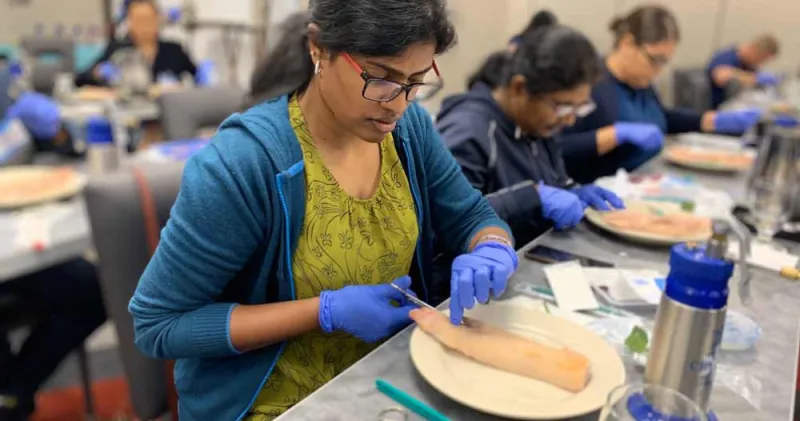
Photo: medical residents attending dermatology training workshop with microscope, via www.empiremedicaltraining.com
For most American dermatologists who attended EADV Vienna 2020, the event delivered what international conferences typically promise: exposure to emerging research, updates on therapeutic pipelines, and the stimulating friction of cross-cultural clinical debate. But for a subset of attendees — particularly residency program directors and academic faculty — the experience carried an additional, less comfortable dimension. Watching European colleagues demonstrate procedural techniques and discuss diagnostic frameworks that simply do not appear in standard US residency curricula prompted a pointed question: how significant is the transatlantic training gap, and who is responsible for closing it?
The answers, drawn from conversations with program directors and faculty who participated in Vienna 2020, are neither simple nor flattering to the American system.
The Competency Divide in Plain Sight
Several of the most heavily attended sessions at Vienna 2020 centered on dermatoscopy — specifically its application beyond melanoma screening, including inflammatory dermatoses, nail pathology, and hair and scalp disorders. European presenters treated trichoscopy and entomodermoscopy as routine clinical tools, embedded in residency training from the earliest years. American attendees, by contrast, frequently noted that dermoscopy instruction in US programs remains inconsistent and often elective, concentrated in fellowship training rather than core residency.
This discrepancy is not merely anecdotal. Survey data presented during the conference's educational symposia indicated that European dermatology residents are assessed on dermoscopic competency as a graduation requirement in a majority of EU member states. In the United States, no equivalent standardized benchmark exists within residency accreditation requirements, leaving the depth of dermoscopy education to the discretion of individual programs.
Procedural dermatology presented a second, equally visible fault line. Vienna 2020 featured extensive programming on laser physics, photodynamic therapy protocols, and advanced wound management — areas where European training programs allocate dedicated rotations. Several US program directors attending those sessions acknowledged that their residents might complete three years of training without performing a single laser procedure under supervision, depending entirely on whether their institution maintained the relevant equipment and faculty expertise.
Structural Barriers, Not Individual Failures
It would be inaccurate to characterize these gaps as the result of complacency among American educators. Program directors who spoke candidly following Vienna 2020 were consistent in identifying structural constraints rather than pedagogical indifference as the primary obstacle.
Residency programs in the United States operate under accreditation frameworks administered by the Accreditation Council for Graduate Medical Education (ACGME), which sets minimum requirements for dermatology training but leaves substantial curricular latitude to individual institutions. That latitude, in practice, means that a resident's exposure to any given subspecialty depends heavily on where they train — the geographic concentration of academic medical centers, the research priorities of their faculty, and the patient demographics of their clinical environment.
European systems, by contrast, tend toward greater national standardization. A dermatology resident training in Vienna, Amsterdam, or Copenhagen encounters a curriculum shaped partly by European Academy of Dermatology and Venereology guidelines that create a more uniform floor of competency expectations. The result, as Vienna 2020 made visible, is a cohort of European trainees who arrive at international conferences with a broader shared vocabulary of clinical skills.
Funding also plays a constraining role in the American context. Laser platforms and phototherapy units represent capital investments that smaller or less-resourced programs cannot easily sustain. The consequence is a two-tier system within US dermatology training itself, where residents at well-funded urban academic centers accumulate procedural exposure that peers at community-based programs simply do not.
Conferences as Informal Curriculum
Perhaps the most striking observation to emerge from conversations with Vienna 2020 attendees was the degree to which international conferences have begun functioning as an unofficial corrective mechanism. Residents and early-career physicians who attend events like EADV Vienna return with exposure to techniques and frameworks that their formal training never provided — effectively using the conference circuit to self-construct a more comprehensive education.
This phenomenon is underreported and carries implications worth examining carefully. On one level, it reflects the admirable initiative of American trainees and young faculty who recognize the limits of their institutional environment and seek to transcend them. On another level, it raises a structural concern: access to international conferences is not equitably distributed. Attendance requires institutional support, personal financial resources, and the professional connections necessary to justify the travel. Residents without those advantages do not benefit from the informal curriculum that Vienna and similar events provide.
Several program directors who attended Vienna 2020 returned with concrete intentions to revise their curriculum, incorporating dermoscopy assessments, expanding procedural rotations, or establishing exchange arrangements with European training programs. Whether those intentions translate into durable institutional change remains to be seen — the history of conference-inspired reform in medical education is littered with ambitious plans that dissolved under the pressure of clinical volume and faculty bandwidth.
A Call for Systematic Examination
What Vienna 2020 ultimately provided was not a verdict on American dermatology training but an unusually clear diagnostic image. The global dialogue that the EADV conference facilitates is, among other things, a form of comparative benchmarking — one that allows American educators to see their curricula reflected against an international standard.
That reflection suggests several areas warranting systematic attention: the standardization of dermoscopy competency requirements within ACGME guidelines, the development of resource-sharing models that give under-resourced programs access to procedural training, and a broader conversation about whether the current residency duration of three years remains adequate given the expanding scope of dermatologic practice.
None of these are straightforward problems. All of them require the kind of sustained, collaborative engagement between American academic institutions and international partners that events like Vienna 2020 are uniquely positioned to catalyze. The conference revealed the gap. The harder work of closing it belongs to the institutions and accrediting bodies that shape what American dermatology residents learn — and what they do not.