The Conversations That Changed Careers: How Vienna 2020 Quietly Rewired American Dermatology's Professional Network
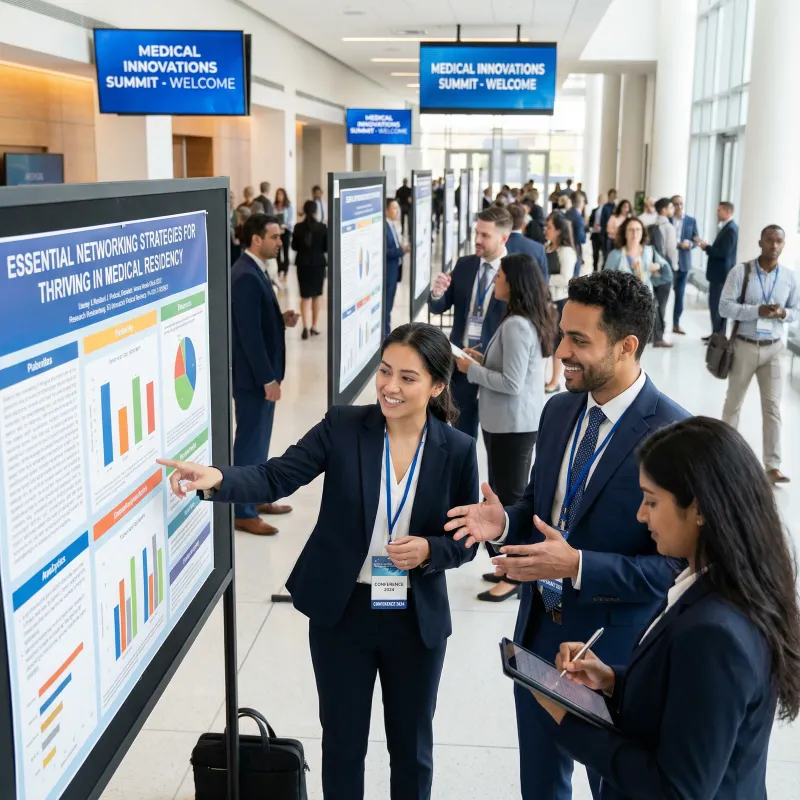
Photo: diverse medical professionals networking at international conference reception, via cdn.residencyadvisor.com
Conferences are marketed on their science. Attendees register for the keynotes, the late-breaking trial data, the workshops that earn CME credit. But ask a dermatologist what they remember most vividly about EADV Vienna 2020, and a surprising number will pause before answering—then describe a conversation. A chance meeting in a hotel lobby. An introduction made by a mutual colleague over dinner in the First District. A business card exchanged with a researcher whose work they had admired from a distance for years.
The formal program of EADV Vienna 2020 was exceptional by any measure. The informal program—the one that existed between sessions, around receptions, and in the particular social chemistry that a city like Vienna generates almost effortlessly—may have been equally consequential for the careers of the American dermatologists who attended.
Vienna as a Catalyst, Not Just a Venue
There is something about the environment of an international conference held in a city with Vienna's intellectual and cultural density that seems to lower professional inhibitions in productive ways. American attendees consistently describe a sense of permission—to introduce themselves to researchers they had previously only encountered in journal bylines, to propose collaborative ideas that might have felt presumptuous in a domestic context, to speak candidly about the limitations of their own clinical environments.
Dr. Sarah Linden, a board-certified dermatologist from Chicago who attended EADV Vienna 2020 as part of a small delegation from her academic medical center, recalls the specific texture of those interactions. "At home, everyone is busy. There's always somewhere to be. In Vienna, you had this unusual experience of being in the same room as people you'd wanted to meet for years, and somehow the setting made it feel natural to just walk up and start talking."
That quality of access—to European researchers, to international thought leaders, to peers from other US institutions one might never encounter at a domestic meeting—is central to what EADV Vienna 2020 offered beyond its printed program.
From Hallway to Research Protocol
Several collaborative research initiatives that are currently active or recently completed trace their origins directly to conversations at EADV Vienna 2020. The pattern is recognizable: a US clinician attends a session on a topic adjacent to their primary research focus, hears something that reframes a problem they have been working on, and finds themselves in conversation afterward with the presenting researcher. What begins as a question becomes an exchange of contact information. The exchange becomes an email thread. The email thread becomes a co-authored grant application.
Dr. Marcus Webb, a dermatologic oncologist at a southeastern academic center, describes this trajectory precisely. He attended a Vienna 2020 session on European approaches to Merkel cell carcinoma surveillance and found himself in conversation with a Dutch researcher whose longitudinal dataset complemented his own institution's patient registry in ways that neither had previously recognized. "We stayed in touch for about six months, and then we realized we actually had the foundation for a meaningful comparative study. That paper is now in review. None of it happens without Vienna."
This kind of serendipitous but substantive collaboration—grounded in genuine scientific complementarity rather than forced institutional partnership—represents one of the less visible but deeply significant outputs of a conference like EADV Vienna 2020.
The Mentorship Dimension
For early-career US dermatologists who attended EADV Vienna 2020, the networking value operated on a different but equally important axis: access to mentorship from senior European clinicians and researchers who brought perspectives shaped by entirely different healthcare systems, research funding structures, and patient demographics.
American dermatology training is rigorous and comprehensive, but it is also, by necessity, shaped by the particular demands of the US healthcare environment—insurance navigation, liability considerations, the pressures of private practice economics. European colleagues, operating within different constraints and incentive structures, often approach clinical and research questions from angles that feel genuinely novel to American trainees.
Amanda Torres, a PGY-4 resident who attended EADV Vienna 2020 with support from her program director, describes a mentorship conversation that began at an evening reception and has continued, via video call, for more than three years since. "She's a professor in Munich who works almost exclusively in rare inflammatory skin diseases. I'm going into academic dermatology with a focus on health equity. We don't overlap on paper at all. But the way she thinks about research design, about asking the right question before you worry about methodology—that has genuinely changed how I approach my own work."
Building Bridges Across Practice Models
One of the more nuanced dimensions of the professional relationships that emerged from EADV Vienna 2020 involves the cross-pollination between US dermatologists in private practice and European colleagues embedded in academic or nationalized healthcare settings. These conversations, which might seem unlikely to yield practical results given the structural differences involved, have in several cases produced valuable insights about patient communication strategies, treatment adherence interventions, and the management of conditions where European clinical experience simply runs deeper.
US dermatologists practicing in community settings have reported that conversations at EADV Vienna 2020 with European colleagues gave them frameworks for discussing biologic therapy with hesitant patients—frameworks developed in healthcare contexts where cost barriers are lower but patient skepticism about newer treatments is not. The transferable insights, stripped of their system-specific context, proved surprisingly applicable.
Sustaining the Momentum
The challenge with conference-born relationships is sustaining them across time zones, competing priorities, and the inevitable entropy of professional life. Several US attendees who formed meaningful connections at EADV Vienna 2020 have been deliberate about maintaining those relationships through structured follow-up—scheduled calls, shared preprint drafts, co-participation in subsequent virtual symposia.
The professional community that coalesced around EADV Vienna 2020 has, in this sense, functioned as something more than a single event. For its most engaged participants, it became the foundation of an ongoing transatlantic dialogue about the future of dermatology—a dialogue that continues to generate ideas, collaborations, and career-defining moments long after the conference itself concluded.
For those considering whether an international conference merits the investment of time, travel, and professional energy, the testimony of EADV Vienna 2020 alumni offers a consistent answer: the science is the reason you register. The relationships are the reason you remember it.